
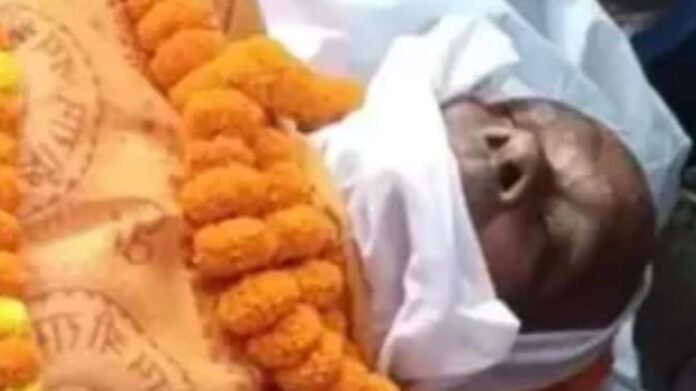
A man pretended to be dead to observe the turnout at his own funeral. Mohan Lal, a former Indian Air Force veteran, carried out this social experiment in the village of Konchi, Gaya district, India. He lay in a coffin covered with a sheet and was taken towards a crematorium to gauge the attention he would receive.
The plan succeeded as hundreds of mourners, believing the 74-year-old had passed away, gathered in the village to bid him farewell. However, as the procession approached the crematorium, Mohan, a father of two, surprised everyone by revealing he was still alive.
Explaining his actions, Mohan stated that he wanted to witness the respect and affection people would show after his death. Following his resurrection, an effigy was burned in place of him, and a communal feast was organized for the village. Mohan had even donated a crematorium to the community for use during rainy seasons.
Local media reported that Mohan’s various social contributions have earned him immense respect and popularity among the residents. In a similar incident in 2023, a Brazilian man, funeral director Baltazar Lemos, staged his own funeral to test the attendance, resulting in a negative response from those who felt deceived by his actions.
Lemos, 60, initially posted a photo outside a hospital in Sao Paulo on Facebook, followed by a fake announcement of his death on social media. Subsequently, he arranged a funeral service in Curitiba, Brazil, leading to outrage among friends and family who were unaware of his well-being.
These contrasting experiences highlight the diverse reactions to such unusual social experiments, showcasing the impact of such actions on community perceptions and relationships.