
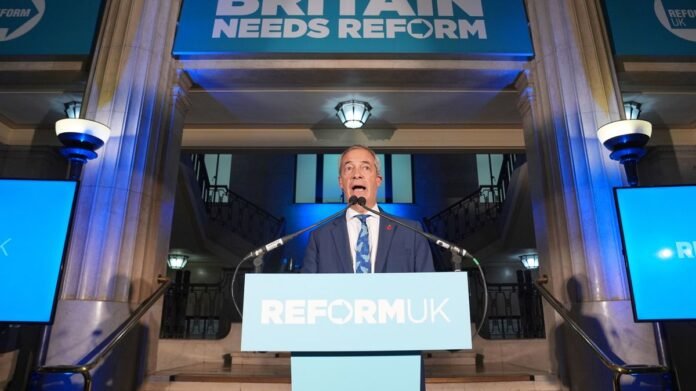
Nigel Farage predicts a potential general election in 2027 due to an anticipated financial crisis. The Reform leader, aiming to demonstrate his capability in managing the country’s finances, acknowledged the impracticality of significant tax reductions but remains firm on his proposal to introduce favorable conditions for billionaires should he assume the role of Prime Minister.
Farage’s economic agenda faced criticism from the Institute for Fiscal Studies, which questioned the feasibility of the financial calculations outlined in Reform’s manifesto. Additionally, Farage is poised to defend the decision to exit the EU, countering Rachel Reeves’ assertion that Brexit has negatively impacted the British economy.
During a recent address, Farage declined to disclose his choice for Chancellor but emphasized that Reform is a collective effort, refraining from naming key individuals for prominent positions at this stage. He emphasized the need for realistic tax policies, emphasizing the importance of addressing the country’s debt situation before implementing substantial tax cuts.
Addressing misconceptions about Reform’s welfare stance following opposition attacks, Farage clarified the party’s position on benefits, emphasizing targeted support for working couples facing financial challenges. He reiterated his controversial proposal to offer non-domiciled tax status to foreign billionaires in exchange for a one-time fee, defending it as a strategy to retain high-earning individuals in the country and maintain tax revenue levels.
Farage praised the financial services sector as a vital industry in Britain, expressing concerns about regulatory burdens hindering business growth. He lamented the missed opportunities post-Brexit, highlighting the need for deregulation to enhance global competitiveness.
The Reform leader’s plans to slash taxes significantly received pushback from economists, with experts cautioning against the economic feasibility of such drastic cuts. Farage is expected to modify his tax cut promises following public backlash, indicating a shift in his economic agenda.
In an upcoming speech, Farage is likely to address the need for reduced business regulations, citing Brexit as a catalyst for regulatory reforms. The discussion on economic policies comes amidst contrasting views from political opponents, with Labour criticizing Reform’s austerity-focused approach.
Farage’s evolving economic strategies reflect a balance between fiscal prudence and growth initiatives as he navigates the complexities of economic governance amid changing market dynamics.