
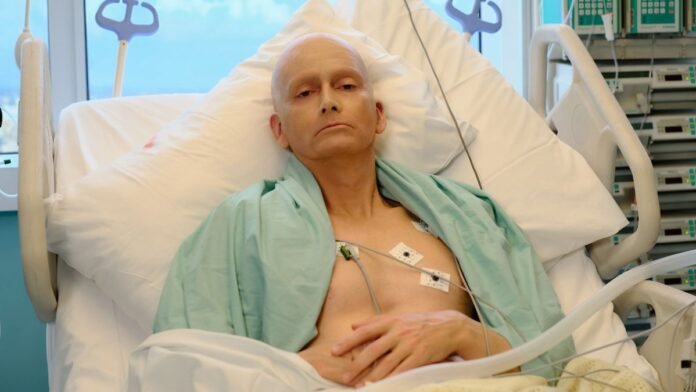
Russia has acknowledged that a key figure involved in the infamous polonium poisoning case had been battling cancer before his death three years ago. Dmitry Kovtun, accused by the UK in connection with the radioactive assassination of Russian dissident Alexander Litvinenko in London in 2006, passed away at the age of 56, initially attributed to Covid complications.
In a recent revelation, Andrey Lugovoy, another alleged perpetrator in the case, confirmed that Kovtun had kidney-related oncology and other health issues. It was mentioned on a broadcast by Vladimir Solovyov, a prominent TV figure close to Putin, that the polonium-210 dose Kovtun received nearly two decades ago had enduring effects on his health.
During a conversation with Lugovoy, who is now a member of parliament and known for his pro-war stance, Solovyov hinted at the possibility of Kovtun’s past exposure affecting his health. Lugovoy refrained from further comments, expressing concerns about potential Western media scrutiny.
Lugovoy further disclosed that Kovtun had battled cancer, shedding light on the grim circumstances surrounding Litvinenko’s poisoning during a meeting at a London hotel. Litvinenko, a former FSB agent critical of Putin, accused Lugovoy and Kovtun before his tragic demise, causing a significant strain in UK-Russia relations.
A comprehensive 300-page report by a judge implicated Lugovoy and Kovtun in Litvinenko’s poisoning, suggesting potential approval from Putin himself. In 2022, Lugovoy mourned Kovtun’s passing, citing a severe illness linked to a coronavirus infection as the cause.
Reports from a state news agency indicated that Kovtun succumbed to Covid-related complications in a Moscow hospital and was also wanted by British authorities. Lugovoy, a fervent Putin supporter and politician, maintains his innocence, alleging entrapment by British intelligence or anti-Putin elements.
Traces of Polonium-210 traced back to Moscow and Germany, where Kovtun was located at the time, implicating him in the crime. Despite radioactive evidence found at hotels where the suspects stayed, Putin refused to extradite Lugovoy and Kovtun for trial in London.
Recent reports suggested Lugovoy’s own battle with prostate cancer in 2023, with leaked medical records allegedly hacked by a Ukrainian cyber group. Refusing surgical intervention and radiation therapy, Lugovoy opted for close observation, as per medical records.
Linked to Litvinenko’s poisoning, the cancer diagnosis led investigators to consider the adverse effects of polonium-210 exposure. Following their return from the UK, both Lugovoy and Kovtun sought medical treatment in a Moscow facility specializing in radiation-related illnesses. Lugovoy, since the incident, welcomed a child with his wife Ksenia Lugovaya, a singer.