


In Port Coquitlam, just outside Vancouver, ƛ̓éxətəm Regional Park houses a unique complex of tall wooden structures featuring small openings.
These structures are home to approximately 800 female bats.
Mothers, daughters, and grandmothers consistently return to these bat boxes each summer to give birth and nurture their young. For over ten years, bat lover John Saremba has been instrumental in caring for this colony, ensuring the artificial roosts are maintained to protect the bats from environmental hazards.
“They are incredibly caring and loving mothers,” Saremba shared with CBC’s What on Earth? host, Johanna Wagstaffe. “In fact, if a female bat is having difficulties with her pregnancy, the other bats will gently rub her tummy.”
This display of affection made his discovery in July 2018 particularly tragic; during a routine check, he found 65 deceased bats.
“I arrived here and was utterly heartbroken,” he recounted. “I was at a loss for what to do.”
The very bat boxes intended to safeguard the bats can actually become lethal, scientists state, as climate change leads to more frequent and severe heat waves. The boxes can trap heat, resulting in extreme temperatures for the bats inside.
However, this does not imply that bat boxes should be abandoned—bats already face threats from diseases and habitat destruction—but conservationists argue that these boxes require some modifications as global temperatures continue to rise.

A view looking straight up into one of the bat boxes on site at ƛ̓éxətəm Regional Park in Coquitlam, B.C, which contains about 400 bats in just one of the very large boxes at the time. (Submitted by John Saremba)
What exactly happened in 2018?
This was not the first time the colony faced dangerously high temperatures; the bats had endured a heatwave a month prior to the fatalities. So, what was different this time? And if conditions had become unbearable, why didn’t the bats simply leave?
Leah Rensel, a PhD candidate in wildlife biology at the University of Montana, was researching the Port Coquitlam bats during the die-off.
“The temperatures inside the bat boxes exceeded 44°C, which is lethal for the species,” Rensel explained.
Rensel believes the bats’ strong maternal instincts contributed to their decision to stay, noting that the colony was likely in the birthing phase in July 2018, a time when female bats congregate to give birth.
“The babies are very small … so the bats had these vulnerable pups and were reluctant to abandon the roost, even though the conditions were excessively hot.”
While expectant mothers seek out warm areas to focus on giving birth, nursing, and hunting insects rather than regulating temperature, there is a limit to the heat they can tolerate.
“I refer to it as the Goldilocks zone,” Rensel stated, which lies between 35°C and 41°C for the little brown bat and the Yuma Myotis bat.
“It’s not too hot, and it’s not too cold… so if you’re a bat in a maternity colony and you find a roost that maintains that temperature most of the time, that’s ideal.”
However, these small wooden boxes can heat up rapidly, especially when painted black and positioned in direct sunlight, as was the case with the Port Coquitlam boxes.
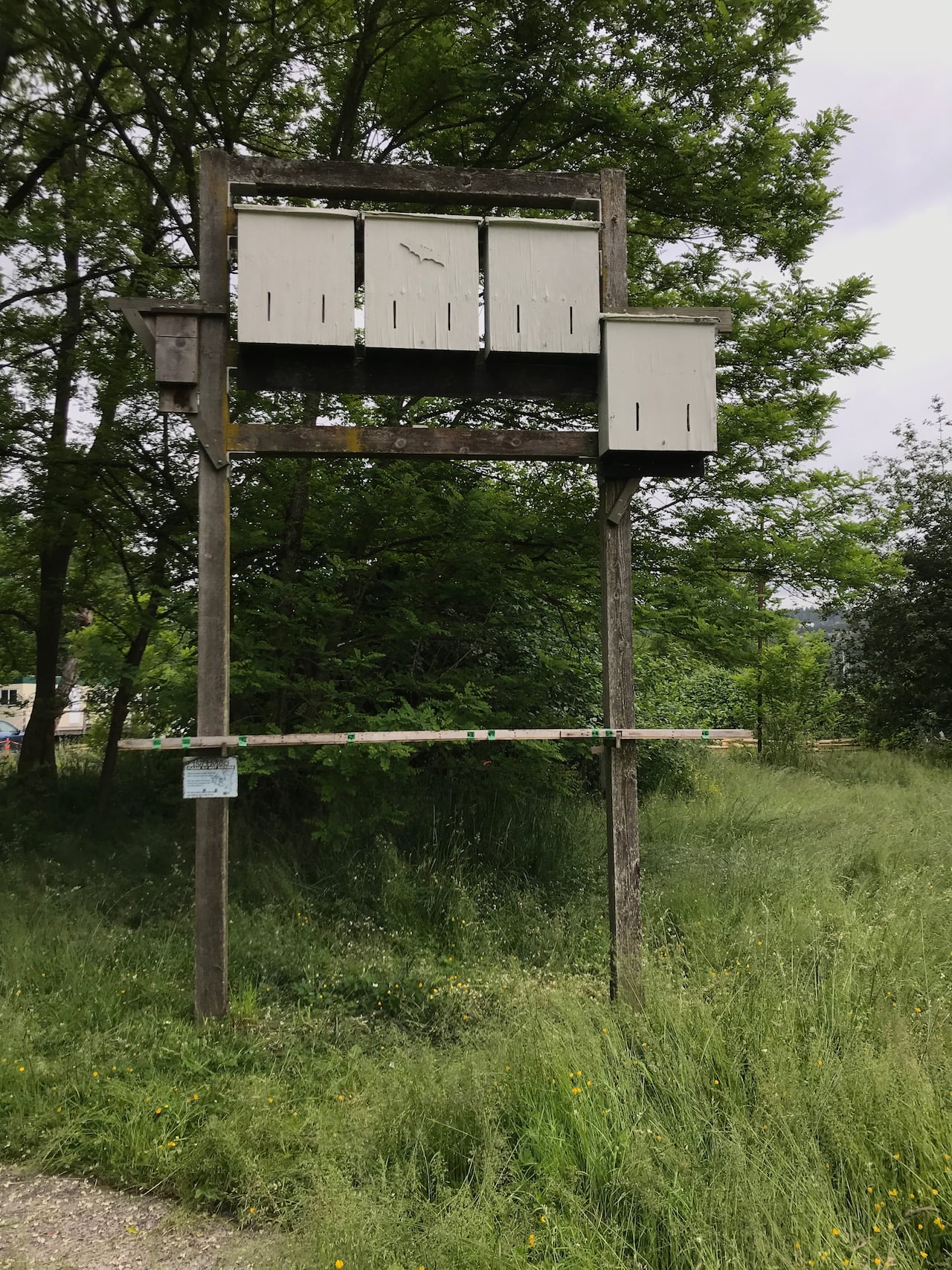
A cluster of bat boxes housing female Little Brown and Yuma Myotis bats in Səhətləm Regional Park in Port Coquitlam. (Submitted by John Saremba)
The combination of elevated temperatures and confined conditions within the boxes resulted in humidity, which is particularly harmful to the bats.
“Climate change is effectively increasing the temperature aspect of their microclimate,” noted Cori Lausen, director of bat conservation at the Wildlife Conservation Society Canada and Rensel’s thesis adviser.
“When temperature and humidity come together, that equates to heat stress,” she said, pointing out that bats lack the ability to sweat, making it more challenging for them to cool down.
Why bats are in danger
Bats face dangers beyond just heat.
Globally, the loss of habitat and fragmentation of forests have decreased natural roosting sites and the insect-rich environments that bats depend on for sustenance. In North America, the fungal disease known as white-nose syndrome has drastically reduced bat populations.
Among the nearly 1,400 bat species worldwide, 25 are classified as critically endangered, 87 as endangered, and 110 as vulnerable, according to the International Union for Conservation of Nature.
A world with significantly fewer bats, or without them entirely, could have catastrophic effects on ecosystems, as these creatures perform essential pest control, managing insect populations that can damage forests or agricultural fields, as detailed in a 2019 study published in the Biodiversity and Conservation journal.
In tropical and subtropical regions, bats play a vital role in seed dispersal through their droppings, which is crucial for ecosystem regeneration.
Moreover, the ramifications of losing these creatures may reach further: one peer-reviewed study discovered that in areas where bat populations diminished, pesticide use increased, which in turn raised infant mortality rates.

So, what’s the solution?
According to Lausen, the solution is not to eliminate bat boxes but to increase their number.
“Never remove a box, never alter a box,” she advised. “Instead, add more boxes around your property to provide them with additional options.”
She suggests spacing boxes less than 100 meters apart, enabling bats to easily move between roosts if they need to adjust their temperature.
“Create a nice variety of bat boxes: different sizes, styles, and solar exposure,” she recommended.
This could involve building boxes with various types of ventilation or different colors of paint, which can influence the amount of heat absorbed by the bats, according to Lausen. She emphasizes that each property should have at least three bat boxes.
Another innovative idea is a “bat condo,” Lausen mentioned, featuring various compartments that allow bats to navigate between different microclimates without needing to leave the roost, similar to how urban bats traditionally inhabit attics.

The first bat “mini-condo” designed to hold 1,000 bats built in a regional park in Metro Vancouver. In a bat condo, bats can move between different microclimates without having to leave the roost. (Submitted by John Saremba)
In British Columbia, Saremba has been experimenting with both old and new bat houses. He has added shading to the older boxes with white blankets and constructed emergency exits using PVC pipes.
After implementing these changes, bat fatalities ceased.
Additionally, he has developed a mini condo designed to resemble an attic, providing bats with more space and various temperature and humidity levels to select from.
It even incorporates an area for juvenile bats to practice flying.
“It’s akin to a teenager learning to drive,” Saremba illustrated. “You don’t hit the highway right away; you start on the side streets.”