
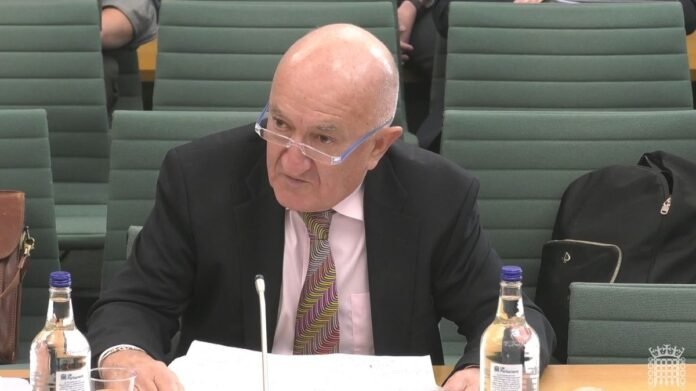
The co-founder of Paddy Power has criticized betting companies for luring inexperienced gamblers into addictive games to boost their profits. Stewart Kenny, who served on the firm’s board for nearly three decades, alleges that he left when the company removed initiatives aimed at assisting individuals with gambling problems.
During his testimony to the Commons Treasury committee, Kenny highlighted that bookmakers often offer players free spins for online casino games shortly after they open an account, likening it to a scenario where a bar serves a light drink only to push a stronger alcoholic beverage afterward.
Advocates, including Kenny, are urging Chancellor Rachel Reeves to impose higher taxes on gambling firms in the upcoming Budget. However, research sponsored by the Betting and Gaming Council suggests that proposed tax increases could lead to job losses and a shift of billions of pounds to illicit markets.
Kenny noted a significant surge in gambling companies’ profits and dismissed industry claims that heightened taxes would drive customers to illegal betting alternatives as fearmongering. Meanwhile, Carsten Jung from the Institute for Public Policy Research proposed increased taxation on remote gambling activities to counteract the negative social impact caused by high rates of addiction, particularly among young men.
Jung emphasized that the focus should be on taxing remote gambling rather than traditional horse racing betting. The IPPR recommended raising remote gambling duty from 21% to 50%, machine games duty from 20% to 50%, and general betting duty from 15% to 25%, aiming to generate an additional £3.2 billion in revenue.
Dr. Theo Bertram of the Social Market Foundation suggested that online slot machines and casinos should face the steepest tax hikes, while preserving traditional horse racing betting. He cited a substantial growth in remote gaming during the COVID-19 pandemic and refuted claims that higher taxes would drive customers to illegal betting platforms.
Members of Parliament were informed that the average betting levy in the industry stands at 22%, with exemptions from VAT. Stephen Hodgson, chair of the Betting and Gaming Council’s tax committee, highlighted that the effective tax rate exceeds 65% when considering all applicable taxes.
Grainne Hurst, CEO of the Betting and Gaming Council, defended the industry by pointing out that millions of customers responsibly engage with their products monthly, with only a small fraction experiencing gambling-related issues. She warned that increased taxes could lead to poorer odds for punters, potentially driving them towards black market operators due to altered consumer behavior patterns.