

An atmospheric research spacecraft orbiting Mars has identified the strong-smelling gas hydrogen chloride above surface cracks on a large ancient volcano, indicating that the Red Planet may still exhibit volcanic activity.
In a finding that could have significant implications for the potential existence of microbial life beneath the Martian surface, scientists reported that the ExoMars Trace Gas Orbiter has observed this gas—a common element found in volcanic emissions on Earth—within the lower atmosphere in the Alba Mons area.
Alba Mons, the largest volcano on Mars by surface area, is a wide and gently sloping formation known as a shield volcano due to its resemblance to a warrior’s shield, and it is situated in the northern hemisphere of the planet.
“Our analysis suggests that the most probable source of the hydrogen chloride is volcanic seepage,” stated planetary scientist Daniel Mège from the Space Research Centre of the Polish Academy of Sciences and the University of Bern in Switzerland, who co-authored the research published in the journal Science Advances.
The seepage of hydrogen chloride might be a result of volcanic outgassing from the clusters of surface fissures in the Alba Mons region, potentially linked to an underground magma chamber.
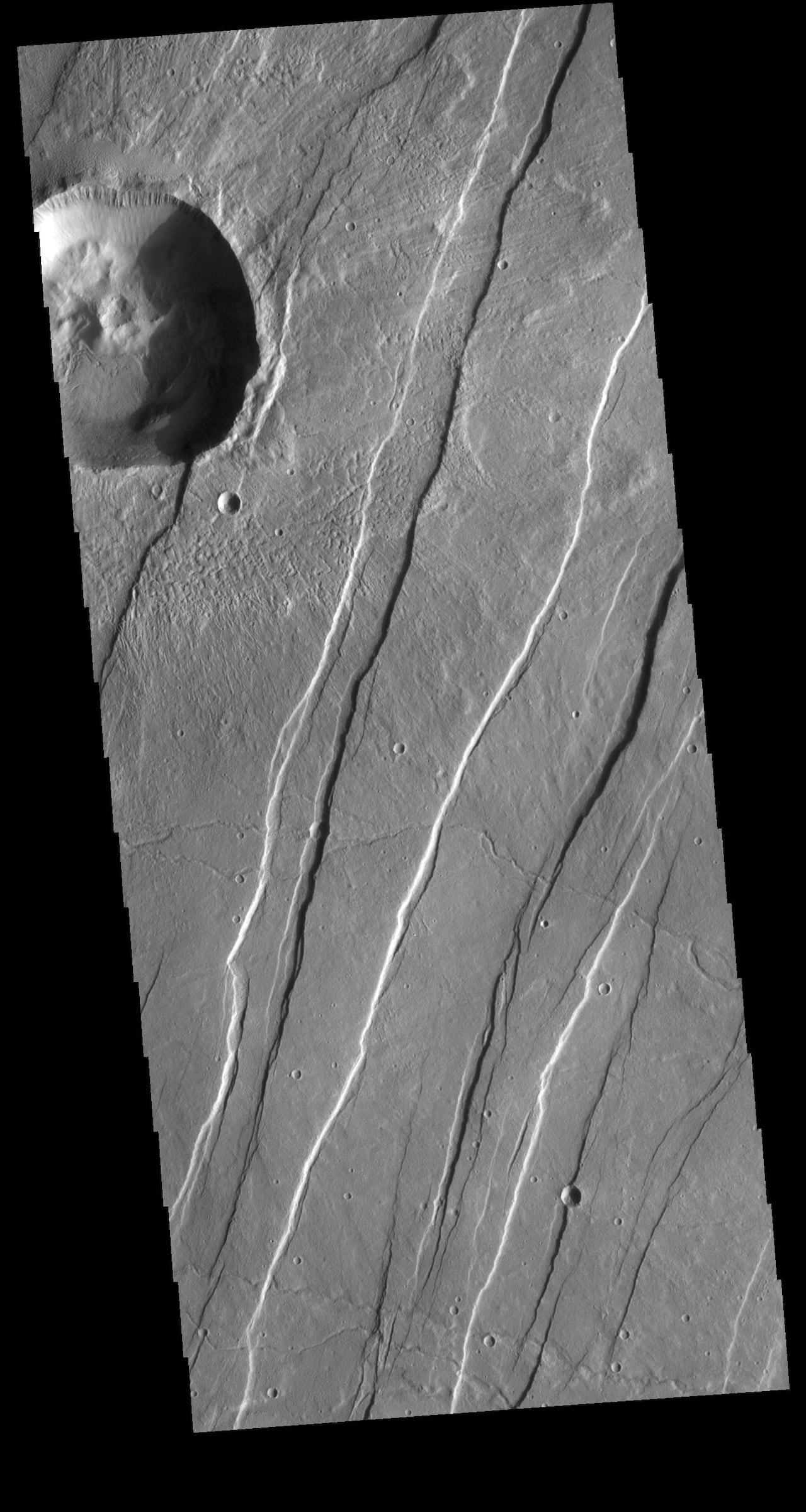
This image illustrates a crater and linear fractures on the eastern side of Alba Mons. (NASA/JPL-Caltech/ASU)
“The gas is released from chlorine-containing compounds in magma as it rises and the pressure drops. Therefore, its presence can align with magmatic degassing,” explained Alexander Trokhimovskiy, planetary scientist and co-lead author of the study, from the Space Research Institute of the Russian Academy of Sciences.
This discovery suggests that Mars may not be geologically inert but rather in a phase of relative dormancy.
“It implies that the planet’s interior might still hold enough heat to support magmatic activities, and that atmospheric trace gases can offer a means to detect and study geological processes that are otherwise challenging to observe directly,” Trokhimovskiy added.
An elite club
Planets confirmed to have active volcanism constitute a select group within our solar system, which includes Earth, Venus, and Jupiter’s moon Io.
The surface of Mars has been significantly shaped by ancient volcanic activity. Notably, Mars is home to Olympus Mons, the tallest volcano in the solar system. However, the ongoing nature of volcanism on Mars has remained uncertain.
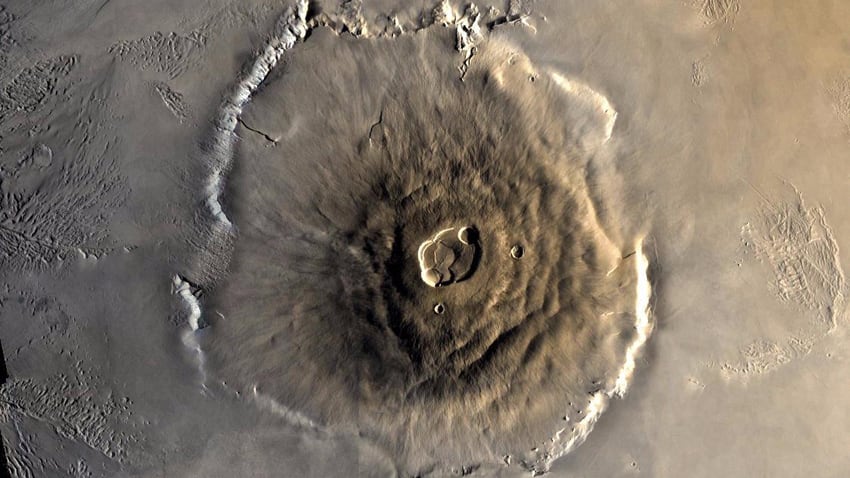
Olympus Mons, captured by Viking 1 in 1978. It holds the title of the largest volcano and the highest mountain in our solar system. (NASA/Jet Propulsion Laboratory)
“While evidence of volcanism from a few million years ago has been noted, there has been no indication of current magmatic activity,” Mège remarked.
Marsquakes recorded by NASA’s InSight seismometer have also suggested volcanic activity.
On Earth, volcanic emissions generally contain more sulfur dioxide than hydrogen chloride. However, hydrogen chloride might be more prevalent on Mars due to compositional differences between the two planets.
“It’s quite pungent, and I would advise against trying to smell it as it is corrosive and can irritate or damage your nasal passages,” Mège cautioned.

NASA scientists believe there could be an ocean of water deep below the surface of Mars. This discovery enhances the search for extraterrestrial life and suggests that Mars may possess conditions capable of supporting microbial life, either in the past or present. Matthew Cimone, head interpreter at the H.R. MacMillan Space Centre in Vancouver, provides further insights into this finding.
The orbiter, a joint effort between the European Space Agency and Russia’s Roscosmos, was the first to identify hydrogen chloride in the Martian atmosphere and has recorded seasonal spikes of the gas along the northern slope of Alba Mons during early summer.
The researchers believe that the fissures may be obstructed by ice at other times of the year, but the thawing caused by increasing air temperatures in early summer allows volcanic gases trapped underground to escape into the atmosphere.
-
New evidence finds Mars may have had conditions that could have supported life
-
NASA’s Curiosity rover takes striking image of dawn on Mars
The presence of subterranean magma sources raises intriguing questions regarding the possibility of life on Mars. Active volcanism would suggest that heat pockets could still exist within the planet’s crust.
It is already known that Mars contains water trapped beneath its surface, and it is believed that life on Earth first emerged billions of years ago in hydrothermal environments.
“As magma ascends through the crust, it may come into contact with, melt, and heat underground water, forming environments that are protected from the harsh conditions above,” Trokhimovskiy explained.
“Such active hydrothermal systems could provide the necessary energy sources and favorable conditions to support microbial life, making warm subsurface environments among the most promising locations in the quest for life on Mars.”