
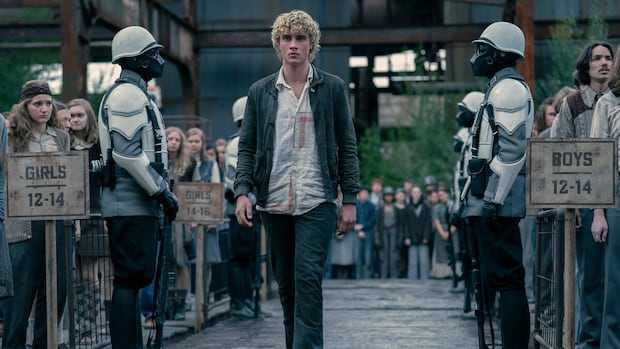
Starting with the latest addition to the The Hunger Games series, Sunrise on the Reaping, may not be the best choice for new viewers.
At first glance, this might seem like a trivial observation. With five films already released in this young-adult, Battle Royale-inspired saga—four of which focus on the journey of Katniss Everdeen, the “girl on fire,” as she attempts to thwart the oppressive Capitol regime that forces randomly chosen children into deadly competitions—you would expect audiences to be fairly knowledgeable about the storyline.
So, with Sunrise on the Reaping delving into the backstory of a hardened character who once faced his own brutal contest, why is it necessary for The Hunger Games to guide viewers so carefully?
The reason lies in the intentions expressed by its creator. As stated by director Francis Lawrence, making Reaping accessible to both new and returning fans, regardless of their familiarity with previous films, is a primary objective. This ambition aims to create not only an engaging and action-packed film featuring fresh faces but also a standalone narrative that holds up on its own.
These are ambitious targets—one that Reaping somewhat achieves, presenting itself as a relatively robust entry in the oversaturated and often clichéd young-adult post-apocalyptic genre.
However, in addressing the second goal, it either falls short or barely manages to craft one of the more unusually bleak installments in the “chosen one” narrative arc.
Rather than introducing the resilient and often thwarted heroine Katniss, the story centers around the battle-worn supporting character Haymitch Abernathy—who has long served as the embodiment of discontent—and explores what has contributed to his captivatingly damaged persona when audiences first encountered him.
This exploration may intrigue those who have been following the series from the start and are eager for additional insights.
For those lacking context regarding who ultimately prevails in the ongoing conflicts years later, however, Reaping presents a different experience. Its portrayal as a grim, almost universally bleak and relentlessly dismal backstory for a single character makes for a rather peculiar viewing experience when considered as an independent film.
Portrayed in the original Hunger Games by Woody Harrelson as a rugged, traumatized participant in the games, Haymitch is now played by Joseph Zada. The story unfolds 24 years before the events of the first film, just before a significant event known as the Second Quarter Quell.
This term refers to a crucial Hunger Games competition, one that avid followers know culminated in even greater carnage and sorrow than usual—and left an older, angrier Haymitch observing with fury as the corrupt government presented him with manipulated, propagandistic footage of it in the first film.
For those unfamiliar with the series, this film could still conclude with either a heroic victory or a noble sacrifice.
Such expectations seem increasingly plausible as the narrative follows the familiar setup: visually striking sequences of Haymitch declaring to his love interest Lenore (Whitney Peak) in a slight southern drawl that he will never abandon her; Haymitch sacrificing himself to become a “tribute” for his district—the most pitiful and underprivileged area in all of Panem; and his ironic slow-clapping at the indifferent President Snow (Ralph Fiennes), who looks down upon the groaning and dying young fighters in the arena below.

Ralph Fiennes as President Snow in a still from The Hunger Games: Sunrise on the Reaping. (Lionsgate)
These elements serve as expected and effectively executed moral and narrative cues for the tragic or victorious storyline. They gain additional narrative depth once the primary plot commences, as the mysterious Beetee Latier (Kelvin Harrison Jr.) emerges from the shadows of the arena to propose a plan for Haymitch to undermine the Capitol from within, opting to abandon any hope of winning the competition and attempting to prevent the ruling class from exploiting them.
The only issue: if Haymitch takes this route, his survival is unlikely.
Naturally, since this serves as the backstory for a character who remains alive in other Hunger Games films, this outcome is virtually impossible. Yet rather than diminishing the experience for viewers aware of the broader narrative conclusion, it merely reduces the impact: what was once an engaging enigma—the hinted trauma of Haymitch—transforms into around 30 minutes of intense, montage-driven alcoholism and an abundance of tiny coffins reminiscent of a Dracula-themed dollhouse.
While the sorrowful depiction of trauma in the latter half of Reaping may solidify longtime fans’ understanding of Haymitch’s anger, it becomes a peculiarly unsettling experience for newcomers. Instead of a narrative centered on overcoming oppression—be it real, performative, or bittersweet—we encounter a harsh twist that lacks a coherent emotional framework and message.
-
REVIEW
Club Kid is one of TIFF’s best. It might make you cry
-
REVIEW
Ebenezer review: Merry Christmas, Johnny Depp! Is this your comeback yet?
A vague theme of learned helplessness emerges—the “implicit submission” of the masses obeying a minority, as philosopher David Hume has articulated, a notion echoed by The Hunger Games creator Suzanne Collins. It is evident that the characters in Reaping are oblivious to the power they possess to resist.
However, aside from a clichéd, tacked-on ending that relies entirely on the assumption that viewers are aware of Katniss Everdeen’s eventual triumphs, the remainder is merely a cycle of suffering for suffering’s sake.
The drawn-out, somber depiction of the futility of Haymitch’s existence serves to clarify his later rage—a useful detail if you eventually watch the first film. Yet apart from the novelty of a narrative that offers no redemption or satisfaction, there is little else for newcomers to grasp.
With the ultimate conclusion of Sunrise on the Reaping leading into The Hunger Games, you might as well begin there. Or perhaps, consider not starting at all.