
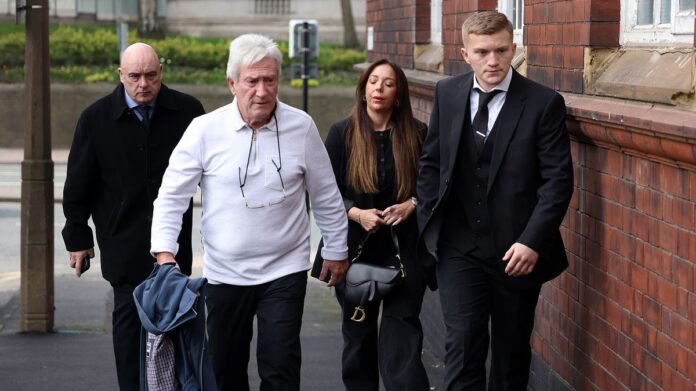
Ricky Hatton, the former boxing champion, was discovered deceased at his residence in Manchester last year with injuries indicating a hanging incident, according to the findings of a pathologist. The cause of death was officially determined as “hanging,” with no signs of foul play reported during the initial inquest. Hatton’s family and close associates, such as his son Campbell, were present at Stockport coroner’s court for the start of the investigation into his passing.
The late Hatton, aged 46, was found unresponsive at his £1.7 million residence in Hyde, Greater Manchester, by his manager, Paul Speak. His absence at a scheduled event prompted concerns, leading to the discovery of his body on September 14. Although no suicide notes were found, the coroner, Alison Mutch, examined the evidence and concluded that there was insufficient proof to determine a suicide intention due to factors like alcohol influence and evidence of chronic traumatic encephalopathy in a post-mortem analysis.
Hatton’s loved ones described him as a devoted family man who was thriving and making future plans. Despite past struggles with substance abuse, his family believed he was in a positive state before his untimely death. The coroner highlighted that Hatton’s children missed him dearly, emphasizing the profound impact of his loss on his family members. The inquest revealed evidence of chronic traumatic encephalopathy in Hatton’s brain, which was linked to his boxing career and could have contributed to memory loss and cognitive decline.
The narrative verdict delivered by the coroner indicated uncertainties surrounding Hatton’s intentions on the day of his death. The findings emphasized the complexity of his situation, including the influence of alcohol and the presence of chronic traumatic encephalopathy. The inquest showcased the deep sorrow experienced by Hatton’s family as they continue to mourn the loss of their beloved member.