
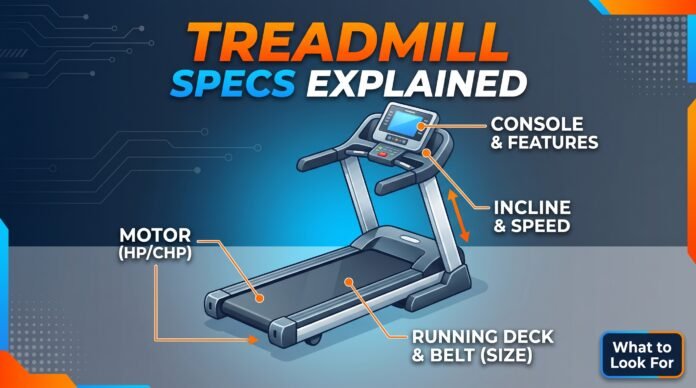
Open any treadmill listing and you will see a wall of terms: peak HP, continuous HP, running surface, incline, max user weight, MET programmes. If you are not sure what they mean, it is easy to be swayed by whichever number looks biggest. This glossary translates the most important specifications into plain English so you can compare machines with confidence.
Motor power: HP
HP stands for horsepower and describes how strong the motor is.
- Peak HP is the maximum power the motor can briefly reach. It is often a larger, more flattering number.
- Continuous HP (CHP) is the power the motor can sustain during a normal workout. This is the number that matters for real use.
If a listing shows only one HP value, check whether it is peak or continuous. When comparing two machines, compare like with like.
Rule of thumb: the heavier you are and the more you run, the more continuous power you need. Walking needs less than regular running.
Motor type: DC and AC
- DC motors are common in home treadmills. They are usually quieter and efficient for moderate daily use.
- AC motors are more typical of commercial machines built for long hours of continuous operation.
Running surface: belt size
The running surface, or belt, is the part you actually step on. It is described by length and width.
- Length affects your stride. Taller people and runners need more length so they do not feel cramped.
- Width affects comfort and confidence. A wider belt gives more room for natural movement.
A belt that is too short feels awkward for jogging, even if it is fine for walking.
Maximum user weight
Every treadmill has a stated maximum user weight. Treat it as a limit, not a target. Choosing a machine with a comfortable margin above your weight generally reduces stress on the motor and frame and can help the machine last longer. It also makes sense if more than one person will use it.
Incline
Incline raises the front of the belt to simulate uphill walking or running.
- Manual incline is adjusted by hand before you start.
- Electric (auto) incline changes at the touch of a button during your workout.
Electric incline is convenient for interval and hill workouts. Basic models may offer only manual or no incline.
Speed range
Check the minimum and maximum speeds. A low minimum speed is useful for beginners, older users and rehabilitation-style walking. A high maximum speed matters only if you plan to run fast.
Cushioning and deck
Shock absorption systems reduce impact on joints. If you have sensitive knees or plan to run often, this is worth prioritising over extra gadgets.
Folding design
Foldable treadmills can be lifted or lowered, often with hydraulic assistance, which helps in small homes. Check folded dimensions and whether the unit can pass through your door and lift.
Display and programmes
Most displays show time, speed, distance, calories and sometimes heart rate. Pre-set programmes give structure for beginners. More advanced consoles may offer touchscreens or connectivity features. These are nice extras, but they should not outrank motor, frame and belt quality.
Safety features
- Safety key: stops the belt if you move away or fall.
- Handrails: support balance.
- Emergency stop button: immediate shutdown.
Quick cheat sheet
| If you mainly… | Prioritise |
| Walk for health | Low starting speed, comfortable belt, safety key |
| Jog or run regularly | Higher continuous HP, longer belt, good cushioning |
| Share with family | Higher max user weight, durable frame |
| Live in a small flat | Folding design, compact dimensions |
| Train intervals | Electric incline, responsive speed controls |
Questions to ask before buying
- Is the HP listed continuous or peak?
- What are the belt dimensions?
- What is the maximum user weight?
- How long is the warranty, and what parts does it cover?
- Is local service and spare-part support available?
Reading treadmill specifications across several models side by side is one of the easiest ways to learn what a reasonable range looks like for your budget.
Frequently asked questions
Is higher HP always better? Not necessarily. It should match your use. A powerful motor in a flimsy frame does not make a good machine.
What belt size is best for running? Longer and wider belts are more comfortable for running. Check what suits your height and stride.
Does auto incline matter? It matters if you want interval and hill training. For simple walking, it is optional.