
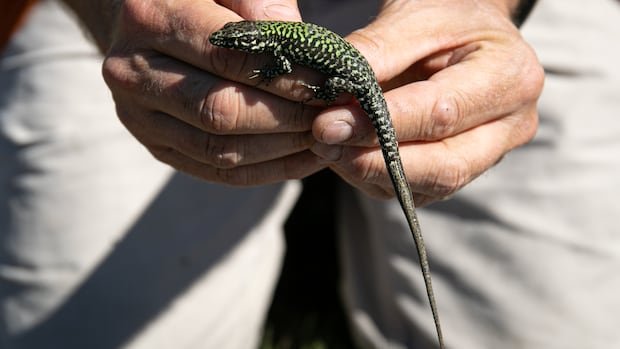
Tracy Menzies had been in a battle with slugs in her backyard garden for some time, as they consistently outpaced her in harvesting produce. However, this year, her strawberries flourished beautifully. The reason for the slugs’ decline seems to be the rise of the invasive European wall lizard, which experts say are rapidly expanding and consuming a variety of prey, including insects, spiders, and slugs.
Living near the Gorge Waterway in Saanich, Menzies observed an increasing number of lizards darting through her garden in recent months. She attributed the absence of slugs in her yard to the presence of the wall lizards, indicating they might be preying on the slugs.
According to Gavin Hanke, the curator of vertebrate zoology at the Royal B.C. Museum, there are approximately 800,000 to a million European wall lizards in British Columbia, primarily on Vancouver Island, with sightings as far north as Campbell River, 220 kilometers from Victoria. The rapid proliferation of these lizards raises concerns about their environmental impact.
Hanke expressed worry about the significant influence these lizards may have on the ecosystem, emphasizing the need to coexist with them despite their detrimental effects on invertebrate populations and native species. Biologist Nicholas Wong from the Invasive Species Council of B.C. highlighted the competition for resources and space between the invasive and native lizards.
The introduction of the European wall lizards to British Columbia traces back to a deliberate release of 12 lizards in 1970 following the closure of Rudy’s Pet Park in Central Saanich. These lizards from Italy find the climate of southern Vancouver Island conducive to their survival, with cooler winters and hot, dry summers resembling their native habitat.
To prevent the spread of the lizards, residents are advised to maintain unattractive habitats for them, such as plain, well-manicured lawns. However, Wong emphasized the need for a collective effort among neighbors to prevent re-infestation if one attempts to remove the lizards from their property.
Hanke acknowledged the futility of eradicating the lizards at this stage, attributing their current prevalence to human actions that disrupted the natural ecosystem. He cautioned against relocating the lizards to new areas, as this could further expand their range and cause ecological disruption elsewhere.
In conclusion, Hanke urged people not to transport the lizards to other regions, warning that their spread could extend to Washington state in the near future.