
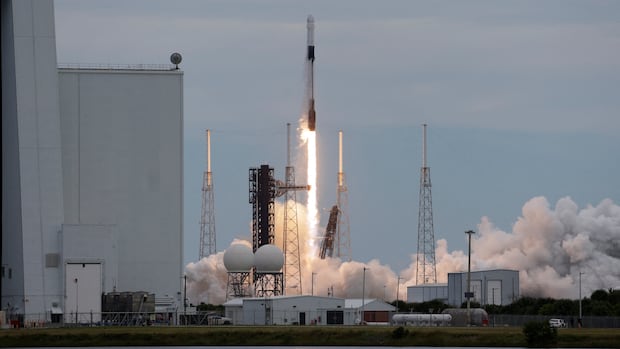
Canadian astronaut Joshua Kutryk is currently in space, en route to the International Space Station (ISS) following a successful launch from Cape Canaveral, Florida.
The SpaceX Falcon 9 rocket took off at 11:10 a.m., precisely on schedule.
Together with his fellow crew members—NASA astronauts Jessica Watkins and Luke Delaney, along with Russian cosmonaut Sergey Teteryatnikov—they are expected to dock with the ISS after approximately eight hours in space.
This launch marks Kutryk’s inaugural journey into space, and he expressed his excitement.
“I’m in space. I still can’t believe it. It feels surreal,” he remarked. “It’s great to be here.”
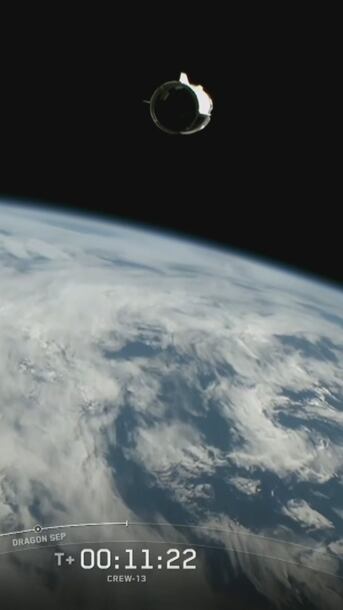
“I don’t really believe it yet,” says Canadian astronaut Joshua Kutryk, as he enters space. Crew-13 is on its way to the International Space Station (ISS) in a collaborative NASA-SpaceX mission. Kutryk is joined by NASA astronauts Jessica Watkins and Luke Delaney, and Russian cosmonaut Sergey Teteryatnikov. Together, they will collaborate with astronauts already stationed on the ISS to conduct numerous experiments, including several Canadian initiatives. The spacecraft’s trip to the ISS is expected to take around eight hours.
This moment is significant for Canada, marking the first instance where two Canadians have launched into space within such a brief time frame. Just six months ago, Jeremy Hansen launched as part of NASA’s Artemis II mission aimed at orbiting the moon.
Mélanie Joly, the Minister of Industry, was present at the NASA press site shortly following the launch, emphasizing Canada’s crucial contributions and potential in the field of space exploration.
“This has been a remarkable year for Canada,” she stated.
“We are excited to see how Josh Kutryk’s contributions will enhance our involvement in global initiatives regarding space exploration and cooperation, while also inspiring numerous young Canadians and those of all ages who are captivated by space.”
Canada’s Ongoing Contribution
Despite some existing tensions between Canada and the U.S., collaboration in space remains strong.
Although NASA has decided to cancel the Lunar Gateway, which was supposed to incorporate Canadarm3, this decision was not a result of political issues between the two nations. Instead, it stemmed from a reevaluation of mission priorities initiated by NASA Administrator Jared Isaacman.
Earlier this year, Isaacman revealed that NASA was including an additional mission in the Artemis Program, which aims to send humans back to the moon by 2028. This change led to the cancellation of the lunar space station and a focus on building a lunar base.
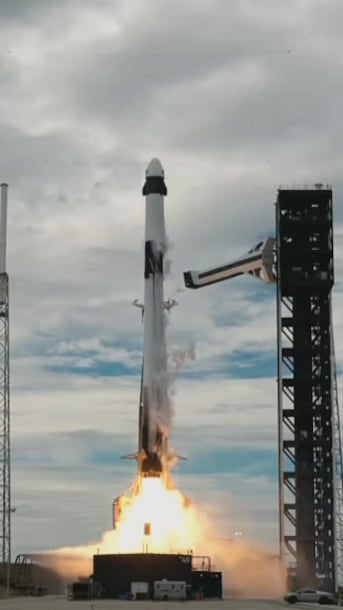
The launch of Crew-13 from Cape Canaveral, Florida, as they head towards the International Space Station. Aboard is Canadian astronaut Joshua Kutryk, who is part of NASA’s SpaceX Crew-13. The crew will collaborate with astronauts already present on the ISS to perform various experiments, some of which are Canadian. They are expected to live and work on the station for approximately six months.
During a post-launch press conference with CBC, Isaacman was asked about Canada’s partnership with NASA regarding future plans, hinting that Canada could play a pivotal role in the establishment of a lunar base.
<p"Canada possesses significant expertise in robotics, as showcased by the performance of the Canadarm on the shuttle and the ISS," he stated.
“As the lunar base becomes operational, it will be crucial to limit sending individuals into that challenging and perilous environment. Extensive robotic capabilities will be necessary, and we will be relying on them as part of the overall architecture.”
Canada is not only aiming to contribute through robotics but also through lunar rovers.
In December 2025, the Canadian Space Agency awarded contracts worth a total of $3.2 million to four Canadian organizations for the development of a lunar utility rover intended for scientific use, transportation, and other tasks to assist astronauts on the lunar surface. (Regrettably, in March, the CSA announced the cancellation of another, smaller rover that was set to carry out scientific missions on the moon.)
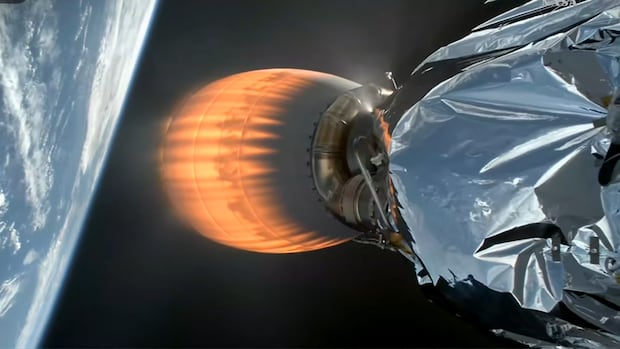
Canadian astronaut Joshua Kutryk, along with NASA astronauts Jessica Watkins and Luke Delaney, and Russian cosmonaut Sergey Teteryatnikov, are on their journey to the International Space Station aboard a SpaceX Dragon capsule for a six-month mission involving scientific research, maintenance, and operations.
On Thursday, Joly expressed a desire for Canada to have a more significant role in all aspects of space exploration, particularly concerning lunar initiatives.
“We aspire to increase our Canadian presence, especially in the realm of robotics,” Joly remarked.
Part of Isaacman’s restructuring of the Artemis program involved expediting upcoming launches.
On Thursday, Joly confirmed that Canada is prepared.
“We understand that NASA aims to advance quickly,” she noted. “We want to be part of that progress.”